



Historic places in the Bulgarian resort of Bansko, inc hidden Thracian town
Submitted by Andy B on Friday, 22 December 2017 Page Views: 4614
DigsCountry: Bulgaria
The so-called “Nameless town” gets its name because this site is not mentioned anywhere in historical documents, legends or folk songs. This is one of the most mysterious archaeological landmarks in Bansko which intrigues tourists and scientists alike. It’s a large ancient Thracian city-fortress and located on the northern foothills of the Pirin mountains 4km. east of Bansko in the direction of the town of Dobrinishte. Amazing things have were discovered at this place but it still hides many secrets.
The excavations after it was discovered accidentally in 2003 by some workmen who were clearing the ground to repair the nearby chapel. They came across great walls which have now been excavated by Bulgarian archaeologists. The dig found an early Christian basilica built at the end of the 4th century, an ancient necropolis and then came to what seems to be an important Thracian town. The town covers a land area of 2.5 to 3 hectares (about 7 acres).The archaeologists found traces of human activity to 3000BC and settled life going back to 2500 BC. The people that lived there were probably ancestors of the Thracians.
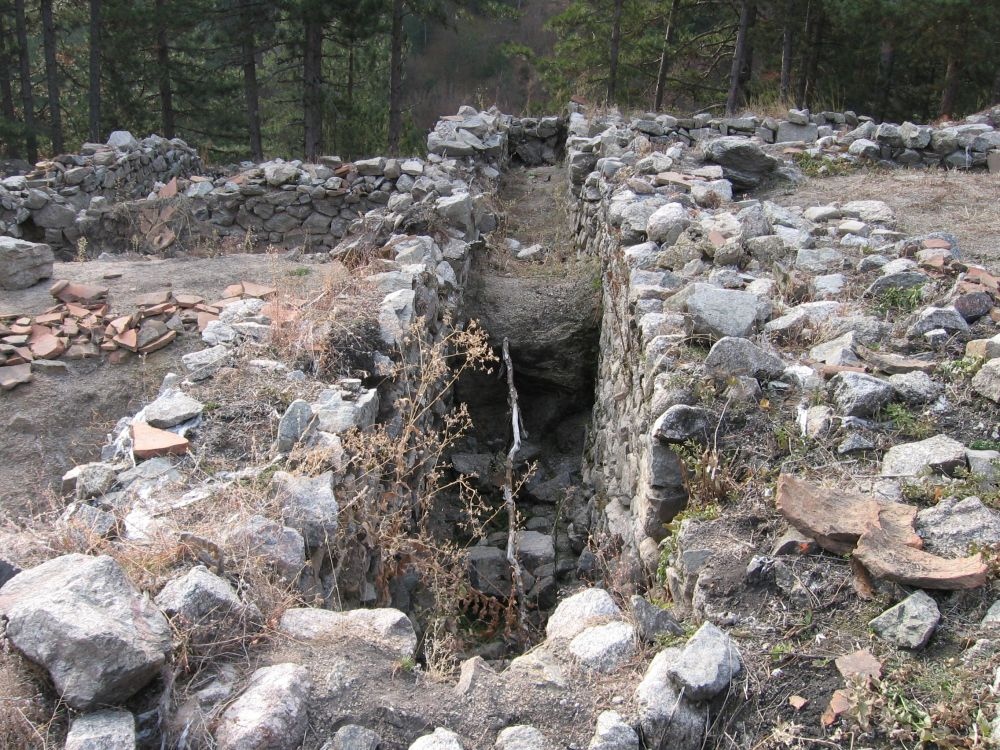 Research into the finds shows a history of continuous occupation from 2500 BC until the 16-17th century. The archaeologists found skeletons 1.80 to 2m in height. who could be considered giants in comparison to the usual size of people from these times.
Many layers of history have been found, with finds such as coins, weapons, instruments, ornaments, ceramics, crockery and glassware of various periods were found in different layers. Many of the objects were decorated, and glassware was also discovered, both signs that the population that had lived there was rich, because glass was an expensive and rare material.
This Nameless Town was built to be literally inaccessible. The cliff which it is built on is precipitous and over 100m high. The town was fortified with stone walls 1.20 m thick, and hasstone buildings and foundations reaching 3m high and 0.65m thick.
A settlement was found outside the fortress wall, and a variety of objects have been found such as axes, knives, arrows, spears, as well as jewellery like rings, earrings, bracelets and others.
The leader of the excavations, Vladimir Baryakov who is curator of the Museum Complex at Bansko believes these lands were inhabited by Thracians from the Daci tribe who were glorified by Homer in Iliad as warlike and brave.
Getting back to sites to visit in Bansko, the town offers many museums featuring ethnography, architecture, history and art.
There is a newly constructed Museum of Otets Paisii Hilendarski which celebrates the life of Paisius of Hilendar, who wrote the popular History of Bulgaria in 1762. He is revered as the forefather of the Bulgarian nationalism and was canonized as a saint.
Another important site is Velyanova House, which with its small windows and walls, resembles a fortress, but has beautiful frescos and carvings inside.
 Many people visit Bansko for its Christian temples - the Holy Trinity Church dated 1835 was for many years the largest church in the Balkans before the Alexander Nevsky Cathedral was built in Sofia.
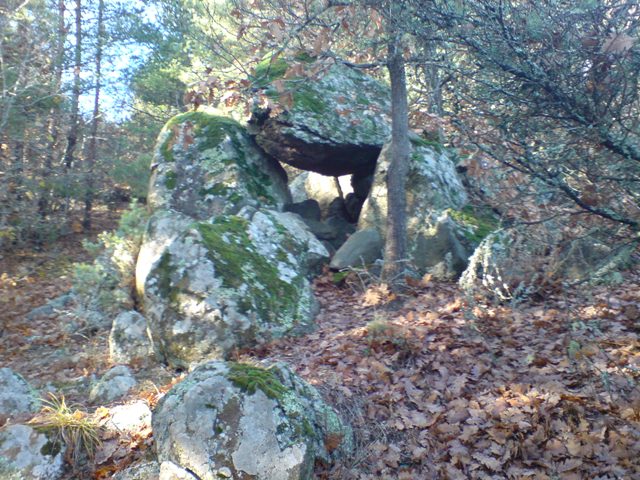
There are also a number of mysterious megalithic sites in the area, one being this site near Eleshnitza which features large propped stones. Many sites including this one have ongoing rituals relating to passing-through the opening of the megalith where people keep alive ancient pagan beliefs. Check out the nearby sites list from that page. This page kindly supported by Lucky Bansko Spa. We have many other ancient sites in Bulgaria to explore listed here.


 We would like to know more about this location. Please feel free to add a brief description and any relevant information in your own language.
 Wir möchten mehr über diese Stätte erfahren. Bitte zögern Sie nicht, eine kurze Beschreibung und relevante Informationen in Deutsch hinzuzufügen.
 Nous aimerions en savoir encore un peu sur les lieux. S'il vous plaît n'hesitez pas à ajouter une courte description et tous les renseignements pertinents dans votre propre langue.
 Quisieramos informarnos un poco más de las lugares. No dude en añadir una breve descripción y otros datos relevantes en su propio idioma.