

A look at the Cahokia Mounds
Submitted by Andy_B on Friday, 22 November 2024 Page Views: 176
Resources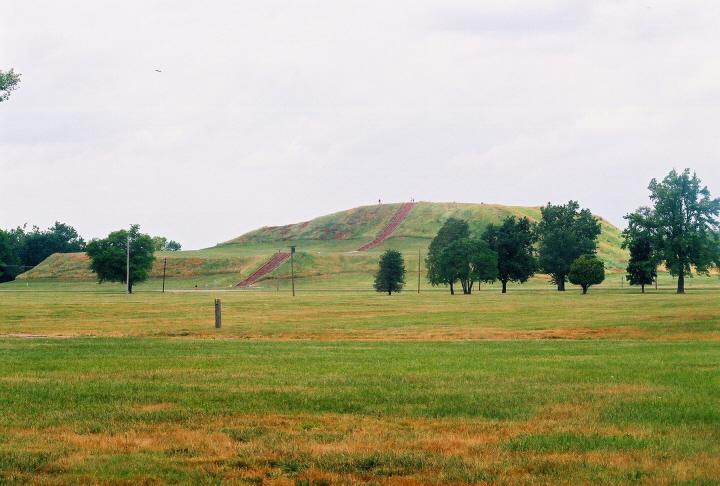
Originally about 120 mounds, destruction has reduced the number to 70, designated as a UNESCO World Heritage site in 1982.
From what archaeologists know so far, Cahokia came to be about 700 AD and stuck around for about four hundred years. It is estimated that its peak population of as many as 20,000 included elites, artisans, and workers.This site was probably the largest urban centre in prehistoric North America.
The Physical Site
What has been learned so far is that the site was laid out with zones - those for governmental functions, for ceremonial activities, compounds for the elite, and residential neighbourhoods for artisans and workers.There was a huge central plaza of about 40 acres that included the Monks Mound, which is the largest prehistoric structure in the Western Hemisphere.
Way of Life
Trade
From excavations thus far, it is known that the people of Cahokia traded with other groups - all the way to the Gulf of Mexico, to the Rocky Mountains, and to the Great Lakes region.Work
Most people were engaged in farming (elites and artisans were the exceptions). Corn was the major crop, and fish were obviously available via the Mississippi for local consumption.Governmental Administration
The elites controlled the Cahokian society and set about clear differentiation between themselves, artisans, and common labourers.- this was most reflected by the neighbourhoods and living situations of each group.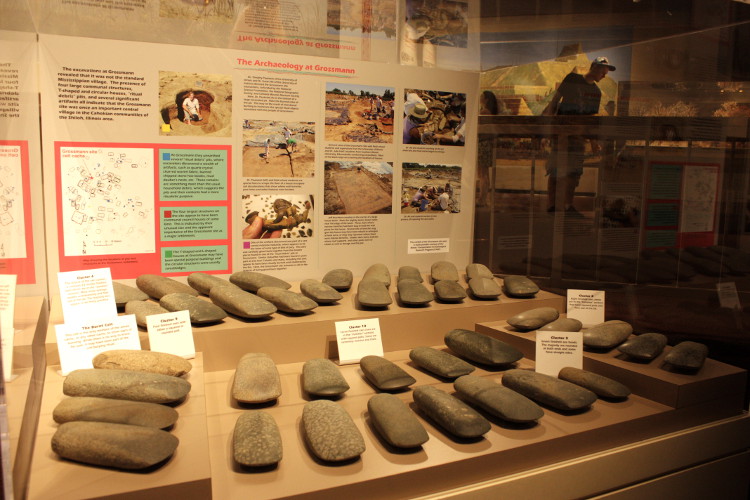
Above: A good display of the stone axes found in various caches at the Grossmann site, 18km east of Cahokia. In the Cahokia Museum.
Decline
Like so many ancient cultures, the decline of the Cahokia people and its structures is not fully known. There is speculation that it was a combination of factors;• Disease
• Warfare - defensive structures suggest threats from without.
• Environmental overuse. The need for fuel and building resulted in the clearing of forests upstream from the main site. This probably caused erosion and flooding and resulted in major crop failures.
Slowly, the main city was abandoned, and remnants of the population moved out in all directions, probably assimilated by other Native American groups.
Study and Excavations
Archaeologists began to study and excavate during the late 19th century, but only a very small amount of the original site has been excavated thus far.Their focus has been on how and why each of the mounds were constructed, how the classes interacted, how the neighbourhoods were determined, and how the entire society interacted with those outside of their city.
The other focus is on preservation of the existing mounds, so they do not face the same destruction that so many of the others have since the 1980s.
Visitors to the site will be able to see an assumed replica of the city and grounds, as archaeologists have been able to determine thus far. Public Interest in Cahokia’s Ancient History The name “Cahokia” was not original to these prehistoric people. It was a name that means “wild geese” and given to the town and site by much later settlers in the 19th century.
And there remains a lot of interest in this site and current excavations, especially by Americans. It is even a subject of discussions in chat rooms all over the web, like this one.
There is much to be learned about the Cahokia Mounds story. And archaeologists will continue their work to learn as much as possible. It’s exciting, so stay tuned! Explore all the sites around Cahokia on our interactive map here.