

A brief overview of British Archaeoastronomy
Submitted by Astronomer on Tuesday, 28 April 2020 Page Views: 4923
Resources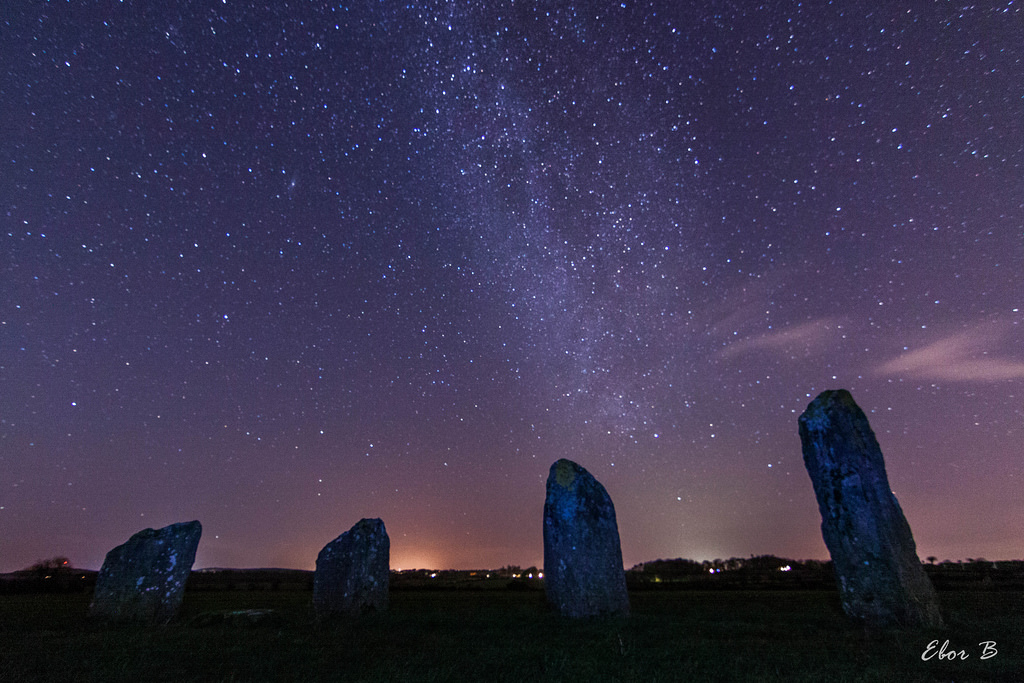
Archaeoastronomy is only now, a century later, starting to take on respectability as a recognized branch of international archaeology. This is largely due to the availability of astronomical planetarium software that allows the user to move backwards or forwards in time to ‘observe’ astronomical events that are otherwise difficult to study without a good understanding of both the mathematical techniques involved and a fundamental appreciation of astro-geometry. If you're looking to try some astronomy yourself you need a good telescope like the Orion skyquest xt8. In the UK and in America, work is being done to understand the importance of astronomy in prehistoric Europe and Asia-Minor, particularly in Egypt and Iraq, and in the very complex and deliberately organised constructions of extinct Central American cultures. Unlike in Egypt, where the importance of astronomy is documented by their hieroglyphs, we can still only apply circumstantial evidence to other contemporary cultures.
Yet we have to acknowledge that in Europe our prehistoric ancestors used the heavens, whether in respect of lunar, solar or star alignments, to carefully position socially important megalithic monuments. The number of astronomically aligned monuments is beyond coincidence although their specific purpose is difficult to interpret. From a purely scientific point of view this is still largely inadmissible evidence but nevertheless the alignments, in many cases, are still there to be seen.
In 1952, Professor Alexander Thom, an engineer at Oxford University, again voiced the argument for archaeoastronomical alignments. His initial publications were in the Journal of the British Astronomical Association and by mid 1954 his observations were becoming more clearly defined. Thom had surveyed the majority of the three hundred or so megalithic sites, mainly stone circles, on the west coast of Scotland to obtain information for a statistical examination of the evidence.
 His basic definitions were as follows: alignments of three or more standing stones; a line from the centre of a circle to an outlier stone; or an upright slab whose upper flat face indicated, or paralleled, a prominent natural feature, for example a mountain peak. Thom found over 200 alignments that were clustered around the rising or setting points of bright stars and, in particular, of the sun at the solstices and at the equinoxes.
First published in 1965, ‘Stonehenge Decoded’ was written by the former Jodrell Bank astronomer, Gerald Hawkins. It caused an international furore by suggesting that the standing stones at Stonehenge were deliberately aligned to allow observation of the heavens. Hawkins had used a powerful IBM computer to analyse all of the possible alignments between the stones at Stonehenge with respect to the sun and moon and had come up with strong evidence for a connection. Like Thom’s stone circles, according to Hawkins, Stonehenge was a prehistoric observatory.
This notion did not sit well with the astronomical community nor with the archaeologists, especially with the archaeologists. Astronomers had no axe to grind; the heavens had always been there. The archaeologists on the other hand could not reconcile what was known about European prehistory, essentially a hunter-gatherer, then farming community, with the sophisticated mathematics needed of prehistoric astronomy. There was simply no supporting or connecting evidence.
It is easy to draw lines between two standing stones and an astronomical object and conclude that it is a deliberate alignment. Hawkins’ and Thom’s ideas that stone circles were designed as astronomical observatories implied a prehistoric culture that could make astronomical observations and had the technical ability to construct observatories; instruments of stone, to monitor the heavens and to carry rather abstract ideas along with them. Weakest in their rationale, deeply criticised by archaeologists, was the necessity for such alignments; did they assist the everyday lives of the prehistoric community or were they abstractly scientific in their design? It was this, more than anything else that clashed with the received understanding of the European Neolithic and Bronze Age. Cultures based on the everyday practical necessities of hunting and farming were unlikely to have supported the mathematical concepts needed to construct their monuments to the required accuracy.
Nevertheless, by the 1980s a few archaeologists were coming round to the idea that some monuments were indeed oriented to intercept or view specific astronomical events. If they had been dismissive of Stone Age astronomical observatories, it did not escape them that a large number of passage graves, particularly in Ireland and Scotland, such as those at Newgrange, Nowlth, Maes Howe and the Clava cairns, did indeed have alignments associated with the solsticial sunrise or sunset. This is not to say that Hawkins and Thom were wrong in their original interpretations, but they may have read too much into otherwise quite genuine astronomical alignments that were not fundamentally ‘scientific’ in their design but which might be reasonably argued to have had some practical or ritualistic importance.
Long before there were gods there was the sun, the moon and the stars. Astronomy is the oldest contemplative religion in the world. Some of us sense this very acutely and find deep solace, a comfort, in drifting across the dark light-years of interstellar space as we study the night sky. The word ‘solace’ says it in one, ‘Sol’, of the sun; of the soul; of the stars. This would have equally applied, perhaps much more so, to the people of the late Neolithic and Bronze Age whose monuments joined their everyday earthly lives with the unfathomable mystery, yet predictability, of the sky.
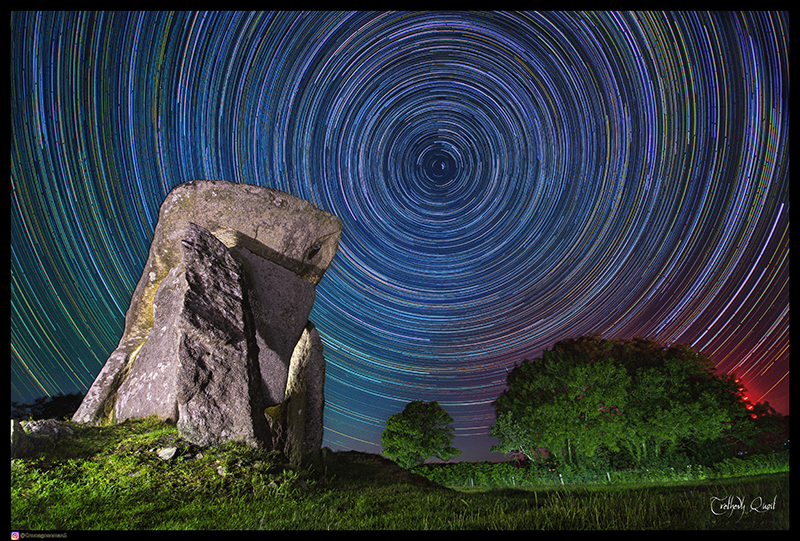 Which way is south? From northern latitudes the sun rises in the east, is highest in the south and sets in the west. Does it matter? Probably not, but from Europe due south is the place the sun occupies when at its highest at mid day and so enables a rough timekeeping midway between dawn and dusk. It is important, especially if you spend most of your life outdoors. It helps you plan outward and return journeys against a known time scale. The phase of the moon is another consideration, right down to the19th century when it was still dangerous to venture out at night. Allied to this is day length, ranging between about sixteen hours in summer and down to half that in winter. The height of the midday sun is helpful but rising and setting points are more accurate. Correlating them against fixed positions on the horizon helps define the seasons, important when it is necessary to know the best time to plant crops and to expect a harvest. Even more important, in the cool of winter, is to know that the sun is at its lowest and following a few more weeks of increasing cold the days will soon become warmer.
This seasonal predictability would have been well worth attempting to define. The majority of us get by with never needing to look at the sky except to judge whether or not it’s the right time of year to plant our vegetable garden without risking nighttime frosts. Our ancestors depended on exactly the same knowledge for planting their crops if they were to survive. Crop failure meant going hungry.
In the British Isles and Northern Europe, many stone circles, long barrows and megalithic tombs were clearly oriented with respect to astronomical objects as they rose or set against prominent horizon features or deliberately positioned standing stones. The Heel Stone at Stonehenge is a classic example of this type of alignment where, from a certain place within the monument, the sun rises at the midsummer solstice against the defining silhouette of a specific outlier. In fact, new interpretations suggest that the midwinter solstice, marking the turn of the year from the dark days of winter towards the spring and summer months, was a more significant time to celebrate.
Archaeoastronomy is slowly becoming respectable; but before jumping to conclusions about your favourite megalithic site, be critical and gather the evidence carefully. Not all stone circles are astronomically aligned and the new discipline is still in its vulnerable infancy if it is to be accepted in the long term by the professionals.
Kevin J Kilburn FRAS Manchester Astronomical Society and the Society for the History of Astronomy
With many thanks to Kevin Kilburn, Ebor Benson, Best Advisor and Paul Crome (cromagnonman) for their kind support and assistance with this article, including their wonderful images.
The Megalithic Portal is looking for high quality, informative feature articles like this one. Can you write between 500 and 1500 words on some aspect of the past? Send your article in from the Main Menu.


 We would like to know more about this location. Please feel free to add a brief description and any relevant information in your own language.
 Wir möchten mehr über diese Stätte erfahren. Bitte zögern Sie nicht, eine kurze Beschreibung und relevante Informationen in Deutsch hinzuzufügen.
 Nous aimerions en savoir encore un peu sur les lieux. S'il vous plaît n'hesitez pas à ajouter une courte description et tous les renseignements pertinents dans votre propre langue.
 Quisieramos informarnos un poco más de las lugares. No dude en añadir una breve descripción y otros datos relevantes en su propio idioma.