

Register here - as a registered user you get more features and fewer ads.
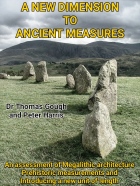
A New Dimension To Ancient Measures by Dr. Thomas Gough and Peter Harris
Although a slim volume, just over seventy-five pages, what it lacks in quantity it more than exceeded my expectations with respect to quality, detail, interpretation and above all, data. This is not by any means a ‘coffee table book’, it is one for those who have a serious interest in the megalithic.
Before reading this book, I was familiar with the concept of the ‘megalithic yard’ and so it should follow that there would be a megalithic foot and inch. This book sets out to describe the megalithic foot – referred to in the text as the ‘HSMF’ – Harris Stockdale Megalithic Foot and is derived from what a mathematician would describe as ‘first principles’.
With the irregularity of shapes and sizes of stones that make up megalithic monuments I was always somewhat sceptical as to how precise measurements could be made. The authors address this by describing a consistent system of defining the positions of stones and therefore a method by which exact measurements can be determined.
In the introduction the authors freely admit that the purpose of megalithic monuments remains unknown – quoting John Mitchel (1982) and Robin Heath (2007) – they do make the connection with certain celestial measurements which are subject to a high degree of statistical analysis throughout the book.
With the assumption that the builders of monuments like Stonehenge, Avebury and the like knew what they were doing a number of questions arise. First is the question of pi (π), a circle with a specific radius can be created using a central peg and a length of rope, both readily available at the time, but a circle with a specific circumference requires a knowledge of the concept of pi. As these circles predate Euclid by several centuries this presents a certain degree of speculation as to how these circles were constructed. The implication is that prehistoric man was rather more intelligent than we have given him credit for. Some of the knowledge could have been through trial and error and independent of any specific units of measurement, e.g. the correct angle for safely leaning a ladder to gain access to a high area is one unit out to four units up, i.e. a ratio. The consistency of the measurements made and calculated by the authors goes beyond this simple imperative for structural security and into the realms of functional design (the exact function will probably never be known).
A universally available resource for prehistoric peoples was the sky. The sun and moon being the most immediate objects that could be observed with the naked eye. In the book, the authors make several references to ‘anomalistic month’, ‘lunar month’, ‘eclipse year’ and ‘solar year’ and use these to analyse the measurements (and include margins of error) taken at various megalithic sites.
The great strength of this book is in the raw data that it provides and then uses to the data to explain the origin and existence of the ‘HSMF’ – Harris Stockdale Megalithic Foot. By providing the raw data the authors are almost throwing down a gauntlet – this is our conclusion, what’s yours?
The link between celestial phenomena and prehistoric society is well documented by the anthropologists linking it to the needs of the early hunter gatherers and their agriculturally based descendants. The conclusion that because of the celestial elements places like Stonehenge were giant calculators, the solstices and equinoxes being important station points of the year, is both reasonable and understandable but and it is a big ‘but’, why was there such a high degree of consistency of measurements (units of length) all across Europe and the ancient civilizations of Egypt, Mesopotamia, the Indus Valley and Babylonia? I suspect these questions will remain
unanswered but this book gives the reader the opportunity to test their own scenarios based on sound measurements and a rigorous description of their limits, accuracy and variability.
Julian A J Rutherford B.Sc., M.Sc.
Something is not right. This message is just to keep things from messing up down the road