

<< Other Photo Pages >> Fossilized Footprints - White Sands National Park - Ancient Trackway in United States in New Mexico
Submitted by AKFisher on Thursday, 19 June 2025 Page Views: 3799
Mesolithic, Palaeolithic and EarlierSite Name: Fossilized Footprints - White Sands National Park Alternative Name: Lake Otero Footprints, Tularosa Basin FootprintsCountry: United States State: New Mexico Type: Ancient Trackway
Nearest Town: Alamogordo, NM
Latitude: 32.801640N Longitude: 106.32496W
Condition:
| 5 | Perfect |
| 4 | Almost Perfect |
| 3 | Reasonable but with some damage |
| 2 | Ruined but still recognisable as an ancient site |
| 1 | Pretty much destroyed, possibly visible as crop marks |
| 0 | No data. |
| -1 | Completely destroyed |
| 5 | Superb |
| 4 | Good |
| 3 | Ordinary |
| 2 | Not Good |
| 1 | Awful |
| 0 | No data. |
| 5 | Can be driven to, probably with disabled access |
| 4 | Short walk on a footpath |
| 3 | Requiring a bit more of a walk |
| 2 | A long walk |
| 1 | In the middle of nowhere, a nightmare to find |
| 0 | No data. |
| 5 | co-ordinates taken by GPS or official recorded co-ordinates |
| 4 | co-ordinates scaled from a detailed map |
| 3 | co-ordinates scaled from a bad map |
| 2 | co-ordinates of the nearest village |
| 1 | co-ordinates of the nearest town |
| 0 | no data |
Internal Links:


External Links:


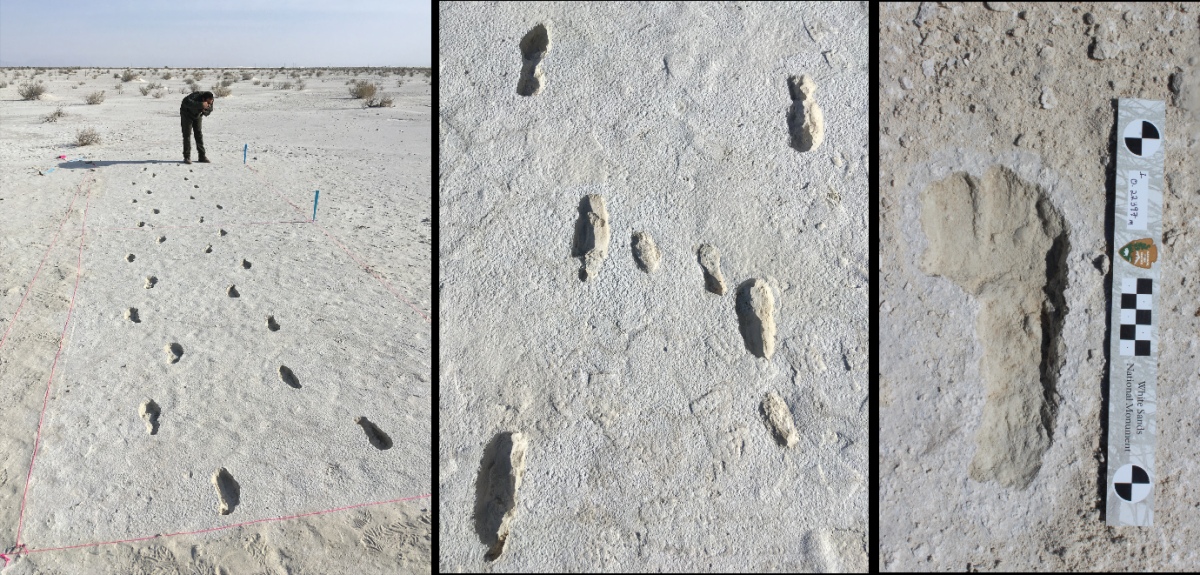
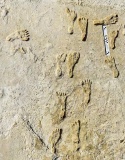
During the 2010s, footprints of a dire wolf were discovered. Some of the human footprints were located next to ancient seeds. Scientists dated these seeds to more than 18,000 years ago, although debate continues as to the actual age and accuracy of the dating, see the comments below.
In 2018, researchers discovered what they believe to be footprints of a female. They tell a story that may seem familiar today; her footprints show her walking for almost a mile, with a toddler’s footprints occasionally showing up beside hers. Evidence suggests that she carried the child, shifting them from side to side and occasionally setting the child down as they walked. The footprints broadened and slipped in the mud as a result of the additional weight she was carrying.
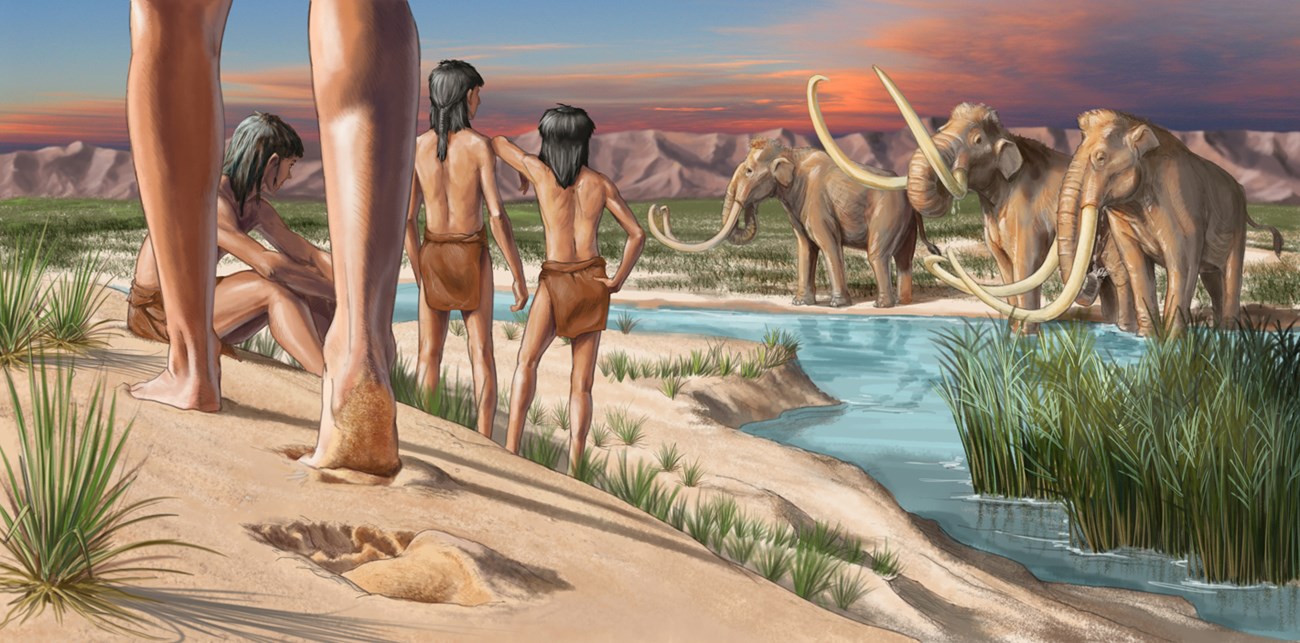
Footprints across White Sands have been found coexisting and interacting with extinct ice age animals. One set of footprints shows what appears to be humans stalking a giant sloth. This is demonstrated by human footprints being found inside the footprints of the sloth as they were tracked. Unfortunately for our hunter, there is no evidence that this was a fruitful hunt.
Although the reason for the disappearance of the great animals of the ice age is still debated among scientists. The ice age ended because of changes in the earth’s climate. Environments once rich in lush green life began to disappear. The fossilized footprints of White Sands are probably the most important resources in the Americas to understand the interaction of humans and extinct animals from the ice age.
These fossilized footprints, among other natural and cultural features found in the dunefield, further propelled the movement to re-designate White Sands National Monument into White Sands National Park. As a massive landscape filled with history, White Sands continually proves to be more than just a sandbox.[1]
Reference:
1. National Park Service ~ White Sands National Park website, "Fossilized Footprints" (see below link)
Further reading and information:
NPS
United States Geological Survey
Directions: From Alamogordo, NM via US-70 W, 16.2 mi. (approximate location ~ visit Park Headquarters for specific directions).
Note: New dating confirms White Sands footprints in New Mexico are 23,000 years old - pushing the date of human arrival in the Americas earlier, more on our page.
You may be viewing yesterday's version of this page. To see the most up to date information please register for a free account.


Do not use the above information on other web sites or publications without permission of the contributor.
Click here to see more info for this site
Nearby sites
Click here to view sites on an interactive map of the areaKey: Red: member's photo, Blue: 3rd party photo, Yellow: other image, Green: no photo - please go there and take one, Grey: site destroyed
Download sites to:
KML (Google Earth)
GPX (GPS waypoints)
CSV (Garmin/Navman)
CSV (Excel)
To unlock full downloads you need to sign up as a Contributory Member. Otherwise downloads are limited to 50 sites.
Turn off the page maps and other distractions
Nearby sites listing. In the following links * = Image available
56.4km SW 235° Summerford Mountain Archaeology District Rock Art
67.2km NNE 26° Three Rivers Petroglyphs* Rock Art
101.8km SSE 165° Hueco Tanks State Park & Historic Site* Rock Art
129.0km S 191° Caballo Blanco de Juárez Hill Figure or Geoglyph
187.1km WNW 285° Gila Cliff Dwellings* Ancient Village or Settlement
229.2km NNW 344° Los Lunas Decalogue Stone* Marker Stone
240.6km WNW 300° Tularosa cave* Cave or Rock Shelter
250.5km WNW 293° Cordova Cave* Cave or Rock Shelter
255.5km N 354° Maxwell Museum of Anthropology* Museum
260.2km NNW 334° Acoma Pueblo Ancient Village or Settlement
262.7km N 351° Petroglyph National Monument Rock Art
262.7km N 351° Petroglyph Nat. Mon.* Rock Art
264.9km N 352° Boca Negra Canyon* Rock Art
311.3km NW 324° Atsinna Pueblo* Ancient Village or Settlement
311.3km SSW 210° Paquime Ancient Village or Settlement
312.2km N 3° La Cieneguilla Petrolyphs Rock Art
313.7km WNW 300° Casa Malpais* Ancient Village or Settlement
323.1km ENE 59° Blackwater Draw* Museum
331.1km N 1° Bandelier National Monument* Ancient Village or Settlement
331.5km N 1° Bandelier National Mounument - Tyuonyi* Ancient Village or Settlement
331.7km N 1° Bandelier National Monument - Long House* Ancient Village or Settlement
331.8km NNW 333° Blue J Ancient Village or Settlement
332.1km N 354° Jemez Gallina Culture* Ancient Village or Settlement
332.2km N 1° Bandelier National Monument - Alcove House* Ancient Village or Settlement
332.4km NNW 332° Casamero* Ancient Village or Settlement
View more nearby sites and additional images

 We would like to know more about this location. Please feel free to add a brief description and any relevant information in your own language.
 Wir möchten mehr über diese Stätte erfahren. Bitte zögern Sie nicht, eine kurze Beschreibung und relevante Informationen in Deutsch hinzuzufügen.
 Nous aimerions en savoir encore un peu sur les lieux. S'il vous plaît n'hesitez pas à ajouter une courte description et tous les renseignements pertinents dans votre propre langue.
 Quisieramos informarnos un poco más de las lugares. No dude en añadir una breve descripción y otros datos relevantes en su propio idioma.