
Visiting Knowlton: A Church Built Inside a Neolithic Henge
Submitted by Andy_B on Wednesday, 04 November 2026 Page Views: 4
Resources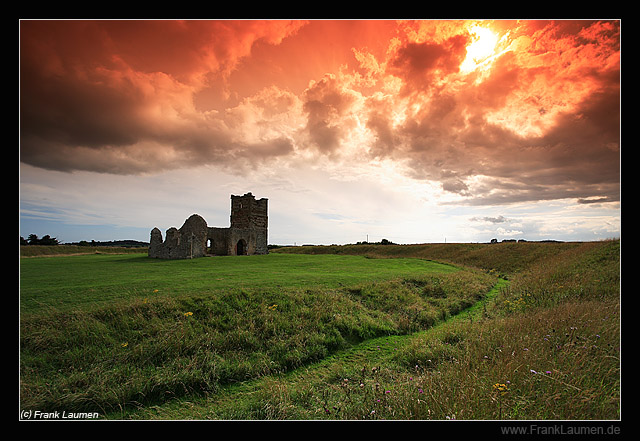
Quick Overview
Knowlton Church is a roofless medieval ruin located within a Neolithic henge in the Cranborne Chase area of Dorset. The church stands inside an oval earthwork measuring roughly 106 metres by 94 metres, its flint walls rising from the same patch of chalk ground where Neolithic communities gathered thousands of years earlier. The combination is striking and rare. Knowlton's main earthwork is a Neolithic henge, and the church placed at its centre creates a visual and historical collision that stops most visitors in their tracks.
The site sits in a small hamlet that has largely disappeared. Once a functioning parish, the area around Knowlton lost its population centuries ago. Today the henge, the church, and the surrounding landscape of burial mounds and crop marks form a protected archaeological complex.
Knowlton is part of a larger ceremonial landscape known as the Knowlton Circles, a cluster of henge monuments and related features that once made this stretch of Dorset one of the most significant ritual centres in southern Britain. The complex includes several henges, dozens of barrows, and traces of activity spanning from the Neolithic period through the Bronze Age, Anglo-Saxon era, and into the medieval centuries.
Knowlton Church is historically significant due to its blend of prehistoric and medieval architecture. You won't find many places in the country where you can stand inside a Christian building that is itself inside a pagan monument. That layering of belief, construction, and abandonment is what makes this a remarkable site worth the journey.
History: From Neolithic Henge To Church Henge
Neolithic Henge Origins
The Church Henge at Knowlton dates from the Late Neolithic, roughly between 3000 and 2000 BC. During this period, communities across Britain built circular or oval earthworks defined by banks and ditches. These henges are thought to have served as gathering places for ceremonies, rituals, trade, or communal decision-making. Henges likely served multiple functions over time, and their exact purpose probably shifted across the centuries they were in active use.
There are nearly one hundred henges in Britain and Ireland, and the Church Henge at Knowlton is among the best preserved. What makes a henge distinctive is its structure: a ditch enclosed by an external bank, creating a defined interior space. At Knowlton, the bank is up to about 10 metres wide and 1.75 metres high. The ditch runs outside the bank, roughly the same width but shallower, reaching about 1 metre deep in the sections that survive best.
Three gaps are visible in the enclosure today, on the south-west, east, and north-east sides, though archaeologists believe only the eastern entrance is original. The others were probably cut through in later centuries.
Surface finds from the area include:
-
Flint tools and worked flint scatters
-
Polished flint and stone axes
-
A stray Neolithic arrowhead
These artefacts suggest sustained human activity over long periods. Comparable lowland henges, such as Mount Pleasant, Durrington Walls, and Marden, all date to the mid-third millennium BC and share similar characteristics, placing Knowlton firmly within a well-documented tradition of monumental construction.
The henge was not an isolated feature. Even during the Neolithic period, the broader landscape around Knowlton was being shaped by communities who chose this particular stretch of chalk downland for their most important earthworks. The henges date from about 3000 to 2000 BC, a span of roughly a thousand years during which the area's significance grew.
Church Henge and Later Use
The landscape around the henge did not fall silent after the Neolithic period. During the Bronze Age, dozens of round barrows were added to the area. These burial mounds cluster within a mile or two of the Church Henge, turning the landscape into a cemetery of considerable scale. The largest of these, the Great Barrow, sits roughly 60 metres east of the henge and remains the most prominent barrow in the county.
Anglo-Saxon burials have been found near the Great Barrow, evidence that the site retained its significance long after the people who built the original earthworks had passed from memory. The land itself seemed to carry meaning forward through the centuries, even as cultures and beliefs changed around it.
Then, in the 12th century, a church was deliberately built inside the henge. The decision to place a Christian building within a pagan earthwork was almost certainly intentional. The combination of a church and henge symbolizes the transition from pagan to Christian worship, a pattern seen at other sites across England where the early Church sought to Christianise places already sacred in the popular imagination.
By siting the church within the henge, the medieval builders were making a statement: this is our place now. The old space was repurposed, its power redirected. The result is a single location where you can trace beliefs and practices across nearly five millennia.
Local folklore includes ghost stories and legends related to Knowlton Church. Some accounts describe spectral figures seen near the ruins at dusk, and others speak of strange lights or sounds within the henge. Whether you find these stories compelling or simply colourful, they add another layer to a place already dense with meaning.
The church served its parish for several hundred years. But the local population dwindled due to the Black Death and economic shifts, leading to church abandonment. By the mid-17th century, the building was described as "unfrequented." Attempts were made to demolish it, but these were prevented. A brief revival around 1730 saw the addition of a north aisle, but ultimately the roof collapsed and the building was left to the elements.
What remains today is a shell: walls, arches, a tower, and the henge that wraps around them all. The church was in use until the 17th century, meaning it served its community for roughly five hundred years before silence fell.
Knowlton Church (Architectural Features)
Knowlton Church was built in the 12th century, and its Norman origins are still clearly visible in the surviving stonework. The church has Norman round-headed arches in its arcade, and these round-arched forms extend to the chancel arch and the south doorway. The construction material is almost entirely flint, with ashlar dressings in Greensand and Heathstone used at openings and structural points.
Key architectural features include:
|
Feature |
Details |
|---|---|
|
Nave |
Approx. 27 ft long × 14 ft 6 in wide |
|
Chancel |
Approx. 12 ft × 10 ft |
|
North chapel |
Approx. 9 ft 6 in square |
|
North aisle |
Very narrow, approx. 5 ft 7 in |
|
West tower (interior) |
Approx. 8 ft 4 in × 8 ft |
|
Construction |
Flint with ashlar dressings |
The arcade separating the nave from the north aisle features the characteristic Norman round-headed arches. These are plain but well-proportioned, and they remain one of the most photogenic elements of the ruin. Some window openings retain plain or trefoiled heads, though many have lost their stonework.
The church features a 15th-century flint tower at the west end. This tower is built of flint with stone bands, and the visible roofline on its eastern face shows where the nave roof once met the tower wall. The tower is the tallest surviving element and the first thing most visitors see as they approach from the road.
A Lady's Chapel once stood at the east end of the north aisle, and the north aisle itself may have been added as late as the 18th century during that brief period of revival. These later additions give the building a layered quality: Norman at its core, with medieval and post-medieval modifications visible in the masonry.
One of the most interesting consequences of the church's placement inside the henge is that its presence helped preserve the earthworks. Because the church occupied the centre of the henge, the interior was never ploughed. While other parts of the Knowlton Circles complex have been damaged or flattened by agriculture, the Church Henge retains its bank and ditch profiles in relatively clean condition. The church, even in ruin, acted as a guardian for the older features beneath and around it.
The space inside the nave is open to the sky. Trees grow close to the walls. The whole place has a quality of stillness that photographs rarely capture. If you visit on a quiet morning, you may find yourself alone with centuries of thought and belief built into every stone.
Nearby Barrows
The landscape around Knowlton is not just about the henge and the church. It is a burial landscape of considerable density and interest.
Within one mile of the Church Henge, RCHME's 1975 survey mapped 15 barrows clustered around the henges, plus four outliers. Many more survive as buried features, visible only as crop marks in aerial photographs or through geophysical survey. These round barrows are burial mounds dating primarily to the Bronze Age, roughly 2500 to 800 BC, and they represent a sustained tradition of using this landscape for funerary purposes.
The most prominent of these is the Great Barrow, located about 60 metres east of the Church Henge. The Great Barrow is the largest individual barrow in Dorset. Its overall diameter, including its outer ditch, reaches approximately 121 metres. It has double ditches, with the outer ditch being discontinuous. Anglo-Saxon burials were also found near this barrow, confirming that it continued to attract attention and use long after its initial construction.
The Southern Circle, another henge in the Knowlton Circles complex, has a ditch 240 metres in diameter. This makes it one of the larger ceremonial enclosures in the area, and though it is less well preserved than the Church Henge, its scale is impressive when you see it on a map or in aerial photography. The Southern Circle at Knowlton is 240 metres in diameter, and its size alone suggests it played a major role in the ritual landscape.
Beyond the barrows, the Dorset Cursus ties into this broader ceremonial geography. The Dorset Cursus runs for over 9km in length, making it one of the longest known cursus monuments in Britain. A cursus is a linear earthwork defined by parallel banks and ditches, and while its precise function remains debated, it is clearly connected to the funerary and ceremonial use of this landscape. The cursus passes through the broader Cranborne Chase area and links Knowlton to a network of sites that together formed one of the most important ritual landscapes in prehistoric England.
Visiting Practicalities
Knowlton Church and its earthworks are located near Wimborne, in East Dorset. The postal address is Knowlton, Wimborne, Dorset BH21 5AE. From Wimborne Minster, the site is reached via minor roads heading north through the Cranborne Chase area. If you're coming from farther afield, Bournemouth is the nearest large centre, roughly 20 miles to the south-east. From London, the journey is approximately 2 hours by road.
The site is managed by English Heritage and is open to the public year-round. There is no admission charge. This means easy access for anyone passing through the area, though the remoteness of the location means you'll need your own transport.
Parking: There is limited parking near the Church Henge. A small layby and verge area accommodate a handful of cars. On busy weekends in summer, you may need to wait or park a short distance away along the road. During quieter periods, the site is rarely crowded, and finding a space is straightforward.
Access and ground conditions:
-
The ground is uneven throughout, with chalk paths, grassy banks, and eroded gullies
-
The henge bank has steep sides in places
-
The church ruin has no roof and partial walls; some areas are unstable
-
In wet weather, chalk ground becomes muddy and slippery
-
There are no toilet facilities on site
What to bring:
-
Sturdy walking shoes or boots
-
Waterproof layers (Dorset weather is changeable)
-
A camera (the site is beautiful in almost any light)
-
Water and snacks if you plan to spend an hour or longer
The site is suitable for families with children who are comfortable on rough ground, but it requires supervision near the ruins and bank edges. Dogs are welcome but should be kept under close control.
For those looking for accommodation, there are hotels in Bournemouth and bed-and-breakfasts in Wimborne Minster, Cranborne, and the wider Bournemouth area. Prices vary by season, and you'll find plenty of deals during the quieter months outside summer. The distance from Bournemouth to Knowlton is manageable as a day trip, leaving time to explore other sites in the area.
Suggested Walk: Church Henge Circuit
A visit to Knowlton is best experienced on foot, with time to walk the full circuit of the henge and take in the surrounding landscape. Here is a suggested route that covers the key features.
Starting point: Begin at the entrance to the Church Henge, where you step through a gap in the bank and find the ruined church ahead of you.
Route:
-
Inside the church. Walk through the nave and chancel. Look up at the tower and note the roofline scar on its east face. Examine the Norman arcade arches and the flint construction of the walls.
-
Circuit of the henge bank. Exit the church and follow the interior edge of the bank clockwise. The bank rises to your left, the ditch lies beyond it. From the top of the bank (if conditions and access allow), you get a clear view of the henge's oval plan and the surrounding fields.
-
East toward the Great Barrow. Leave the henge via the eastern entrance and walk roughly 60 metres to the Great Barrow. Its scale is not immediately obvious from ground level, but as you approach, the gentle rise of the mound becomes apparent. The double ditches are best seen in aerial photos, but even from the ground, the barrow's extent is impressive.
-
North-west toward other features. If time permits, continue north-west to view the Northern Circle and other ring ditches. These features are less well preserved but extend the walk and your understanding of the landscape.
-
Return to the Church Henge. Loop back to the starting point.
Total distance: 2.5 to 4 km depending on how many features you include.
Photography tips:
-
Early morning and late afternoon light is best. The low sun casts long shadows that accentuate the banks and ditches, making the earthworks far more visible than they appear at midday.
-
Crop marks in surrounding fields are most visible in dry summer conditions and from elevated positions.
-
The view of the church tower framed by the henge bank is the classic shot. Position yourself on the south-west side for the best angle.
-
Photos taken on overcast days often capture the atmosphere of the ruins more effectively than bright sunshine.
Timing your visit:
The site is rarely crowded, but if you want the place to yourself, arrive in the early morning. Dawn visits in summer are particularly rewarding: the light is golden, the air is still, and you can enjoy the space without other visitors. Weekday mornings outside school holidays are also reliably quiet.
Allow at least one hour for a thorough visit. If you plan to walk the full circuit including outlying barrows, budget closer to two hours.
Footwear: The paths are chalk with shallow eroded gullies. Solid walking shoes or boots are essential. Sandals and thin-soled shoes will not serve you well here, especially if the ground is damp.
Conservation and Etiquette
Knowlton Church and the surrounding earthworks are a Scheduled Ancient Monument with legal protection. The site has survived for thousands of years in part because of careful stewardship, and every visitor plays a role in keeping it intact for the future.
Path discipline: Stay on marked paths and within the established walking areas. Walking on the henge bank accelerates erosion, and the bank is one of the most fragile and important features of the site. The ditch sides are similarly vulnerable.
Leave no trace:
-
Remove all litter, including food wrappers and water bottles
-
If you bring a dog, clean up after it
-
Do not remove any stones, flint, or other material from the site
-
Do not climb on the church walls or tower
Before you visit:
-
Check seasonal conditions, especially after prolonged rain. The chalk ground becomes unstable and muddy, and access may be difficult.
-
Verify any temporary closures or management changes through the English Heritage website.
-
Excavations at Knowlton have occurred over the past 25 years, and on rare occasions, active archaeological work may restrict access to parts of the site.
Respect the place. Knowlton carries the accumulated meaning of five millennia of human presence. Whether you view it through the lens of archaeology, architecture, spirituality, or simple curiosity, treating the site with care is the minimum it deserves.
Further Reading and Sources
If your visit to Knowlton sparks a deeper interest, the following resources provide detailed archaeological and historical context.
Academic publications:
-
Survey and excavation at Knowlton Rings, Woodland Parish, Dorset, 1993–5 by Stephen Burrow and John Gale, published in the Proceedings of the Dorset Natural History and Archaeological Society. This paper covers the field survey and excavation results from the henge complex.
-
The Knowlton Prehistoric Landscape Project based at Bournemouth University. This ongoing research programme has conducted detailed field surveys, excavations at High Lea Farm, and studies of the barrow cemeteries around Knowlton.
Heritage records and designations:
-
Dorset Heritage Explorer: Monument records MDO6416 (Church Henge) and MDO40029 (Church and Enclosure) provide detailed descriptions, dimensions, and condition reports.
-
Scheduled Monument Number 35209: "Group of henge monuments, an associated group of round barrows, a Saxon cemetery, and a Norman church at Knowlton." This is the official scheduling documentation.
-
Historic England listing for the Ruins of Knowlton Church (Grade II*) includes architectural details and conservation notes.
Official visitor information:
-
The English Heritage page for Knowlton Church and Earthworks provides directions, opening information, and a brief historical summary. This is the best place to check current access status before your visit.
Broader context:
For those interested in the wider landscape of Cranborne Chase and its prehistoric features, the river valleys and chalk downs of this part of Dorset contain one of the densest concentrations of Neolithic and Bronze Age monuments in southern England. The Dorset Cursus, the Knowlton Circles, and the barrow cemeteries together form a ceremonial landscape that rivals better-known sites elsewhere in the country.
Knowlton is a place where the familiar and the ancient occupy the same ground. A church that families once attended for Sunday services stands inside a monument built two thousand years before Christianity reached these islands. The reconstruction of meaning at this site happened not through demolition but through addition: each generation chose to build upon what came before rather than erase it.
Few places in England compress so much history into such a compact and accessible location. Whether you come for the archaeology, the architecture, the photography, or simply the walk, Knowlton rewards the time you give it. Choose a quiet morning, bring comfortable shoes, and let the place speak for itself.