

The Wedjat Eye and the Egyptian gods who reached Roman Britain
Submitted by Andy_B on Tuesday, 03 November 2026 Page Views: 4
Resources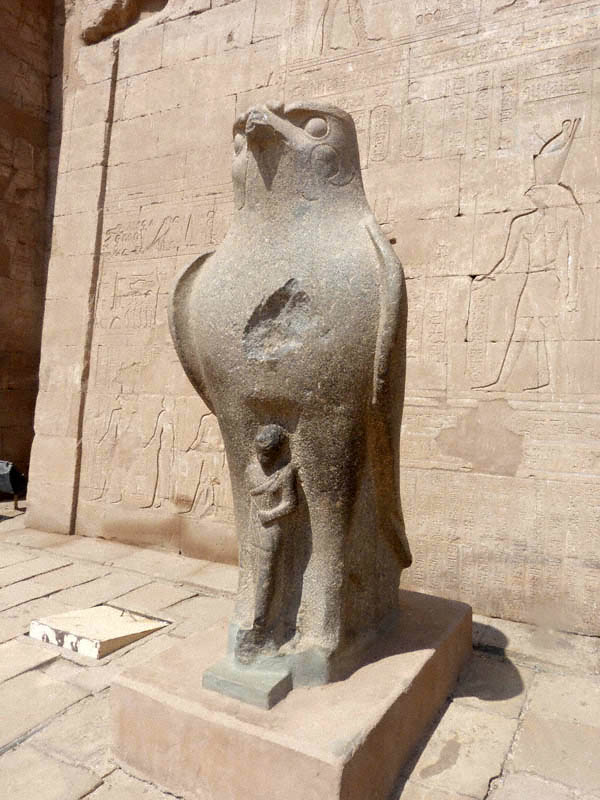
The eye that was made whole
The ancient Egyptian name means "the one that is sound (again)". In the myth, the god Seth injured or stole the eye of Horus, and another god, Thoth, restored it. One account adds that the eye's magic was so powerful that Horus's father, Osiris, was revived when Horus offered it to him.The design combines a human eye with the markings of a falcon, the bird of Horus. It stood for healing, regeneration and wholeness, and an amulet in its shape was thought to protect the wearer.
Worn in life, wrapped with the dead
Wedjat amulets are known from the late Old Kingdom and continued to be made into the Roman period, in stone, faience, glass and metal. Pierced for a cord, a wedjat could be strung as jewellery or attached to a mummy; amulets for the dead were laid on the body or between the bandages.National Museums Liverpool shows both sides of that story. One stone wedjat in its collection was among 24 amulets from the mummy of Djedher at Abydos, from Flinders Petrie's excavations. Two more, one of faience and one of Egyptian blue frit, were found at Tanis during Petrie's 1884 excavations, in a building recorded as "Roman House 12".
Gods who followed the traders
Isis was established in Alexandria by Hellenistic times, and her link with traders and sailors helped carry her worship out of Egypt. By the first and second centuries AD, Miranda Green wrote in 1983, she had established herself all over the Roman world. Osiris, meanwhile, had been recast in Hellenistic times as a new god, Serapis.In Britain the trail is thin. In 1965 Eve and John Harris called the evidence for Egyptian religion in Roman Britain "both sparse and problematical", and Green noted that nearly all of the few finds of Isis come from London, a trading centre that would have been thronged with merchants and travellers from overseas.
A temple of Isis in London
When it was found, says the London Museum, a pottery jug from Southwark was the first evidence for her cult in Britain. Made in the late first century, it carries a faint graffito on its shoulder: Londini ad fanum Isidis, "At the temple of Isis, London".The temple itself has not been found. But in 1975, excavation in Upper Thames Street uncovered an altar reused in the Roman riverside wall. It records that the governor, Marcus Martianius Pulcher, "ordered the restoration of the temple of Isis which had collapsed from … age", some time between AD 221 and 260. London has also produced two model iron sistra, the ceremonial rattles used by priests of Isis in processions.
Isis even turns up beside a country shrine. In 1981 a metal detectorist found a bronze figurine, 63mm long, near the Romano-Celtic temple at Thornborough in Buckinghamshire. From her tall ostrich-feather crown, Green identified her as probably Isis, likely made in the second or third century, and called figurines of Isis "extremely rare in Britain".
Serapis in York and London
In 1770 a stone slab was found near Tanner Row in York. In translation it reads: "To the holy god Serapis Claudius Hieronymianus, legate of the Sixth Legion Victrix, built this temple from the ground." The Roman Inscriptions of Britain dates it between AD 190 and 212 and notes that the emperor Septimius Severus was also a devotee of Serapis. Severus died at York in February 211. The slab is now in the Yorkshire Museum.London has its own Serapis: a polished marble head of the mid-second to mid-third century, with a corn measure on his head. It was found in 1954 during excavations of London's temple of Mithras, deliberately buried with a figure of Mercury in a shallow pit in a fourth-century floor.
An old eye on a new screen
The eye of Horus also has a life far from the museum case. Fortune Games publishes an Eye of Horus slot guide that explains how Blueprint Gaming's ancient Egyptian-themed game works, with the Eye of Horus, Anubis, scarab and ankh among its symbols. The game is for adults aged 18 and over only; every spin is random and the odds favour the house, and no amulet or symbol changes a random result.In Roman Britain, Egypt's gods survive in a handful of objects, among them a jug, an altar and a marble head from London, a slab from York and a small bronze goddess from Buckinghamshire.
18+ only. Treat any game as paid entertainment, never a way to make money. Free, confidential help 24/7: National Gambling Helpline, 0808 8020 133.
