


More about ancient megaliths and how they were created
Submitted by Andy_B on Thursday, 02 April 2026 Page Views: 330
Resources
What We Know About Ancient Megaliths in Europe and America and How They Were Built
Someone, approximately 6,000 years ago, looked at a 150-ton block of limestone in southern Spain and thought, “I’m going to move that.” They had no wheels, no metal tools, and no written language. They moved it anyway, placed it on a foundation of rock, stacked more rock on top of it, and constructed a structure, the Dolmen of Menga, that still stands today.A study published in the journal Science in 2024 theorized that the ancient builders had much more complex and refined knowledge of construction than history typically grants them. In summary, this encapsulates the paradox of megalithic construction. The people who constructed these edifices obviously knew what they were doing, but they left no written clues as to how or why.
What Are Megaliths and Where Are They Found
The term “megalith” is derived from two Greek words: "megas," meaning great, and "lithos," referring to stone. Therefore, the term “megalith” refers to any enormous stone that is part of the structure of a prehistoric monument, either standing alone or in combination with others. According to the megalith entry in Wikipedia, there are more than 35,000 megalithic structures identified in Europe alone, stretching from Sweden to the Mediterranean region.Similar structures exist in the Levant, Asia, and the Americas, indicating that megalithic monuments are not exclusive to Europe. This phenomenon demonstrates that the interest in discovering historical treasures is as accessible as choosing an online casino. In this sense, portals like Slotozilla allow you to find the best 1 pound deposit casino option for playing without large investments. These guides help you discover the best offers before exploring new discoveries. This same level of exploration allows us to understand the differences between European and American megaliths.
Famous Megaliths in Europe
The most concentrated collection of megalithic sites in the world is in Europe. France has between 5,000 and 6,000 dolmens and the same number of menhirs. The sites listed here are from different periods, with different purposes and different building techniques:• Stonehenge (England, 3000-1500 BCE): the most recognized megalithic construction in the world. The construction was developed in stages over 1500 years and consists of concentric rings of massive sarsen stones.
• Carnac Stones (Brittany, France, ~4500 BCE): over 3,000 standing stones in parallel rows over several km. The alignment with celestial features suggests that it was likely developed for ritual purposes.
• Dolmen of Menga (Antequera, Spain, ~3800 BCE): one of the largest megalithic structures in Europe. The construction consists of 32 blocks of limestone with a total weight of 1140 tons. The largest stone weighs 150 tons.
Archaeologists have discovered a submerged 120-metre long wall made of granite, buried nine meters below sea level off the coast of Brittany. The International Journal of Nautical Archaeology announced in December 2025 that the submerged wall is 7,000 years old, which predates European megalithic culture by several hundred years.
Megalithic Structures in the Americas
Similar stone construction is also found in America, although the age of these is generally younger, and their association is more likely to be ceremonial centers rather than burial chambers. The major American sites and their characteristics:• Tiwanaku (Bolivia, ~200-1000 CE): a pre-Inca ceremonial center near Lake Titicaca. The Gateway of the Sun is made of a single piece of andesite rock. The precision of the stonework, where some of the stones are fitted without mortar to within less than 1 mm.
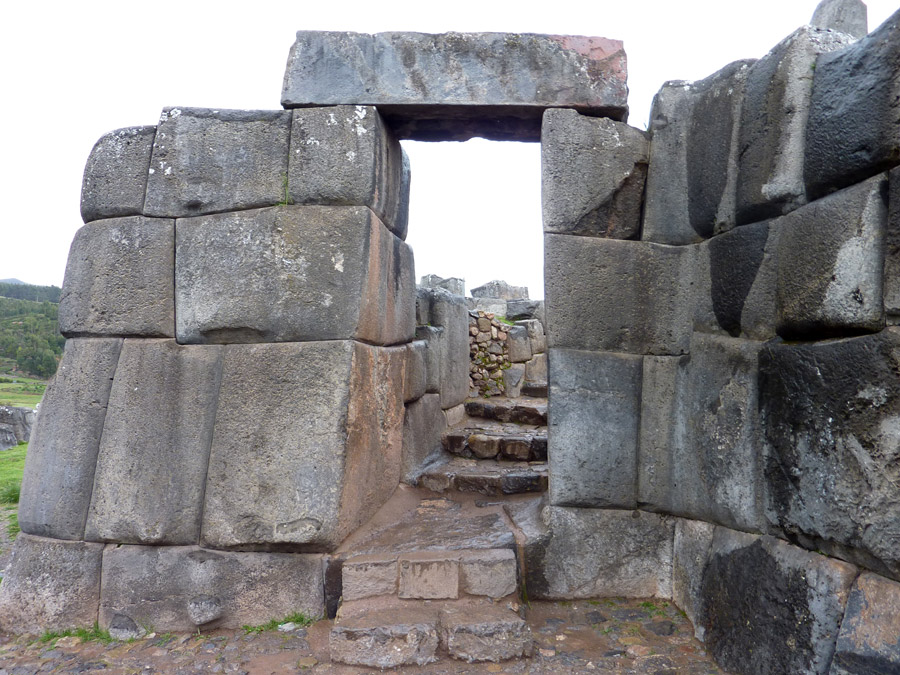 • Sacsayhuamán (Peru, ~1400 CE): (pictured right) a fortress constructed by the Incas near Cusco, built from limestone blocks weighing up to 130 tons. The stonework is polygonal and interlocking, so tight that a knife blade will not fit between the blocks.
• Poverty Point (Louisiana, USA, ~1700 BCE): a complex of earthwork mounds built by hunter-gatherers before the introduction of farming in the area. Although not a stone construction, the site implies a similar level of organization.
While there are differences between the megaliths of Europe and America, these are not so much in terms of capabilities as in terms of materials and objectives. The Europeans used stone slabs, often as tombs.
When and Why Megaliths Were Built
The European megalithic structures are found to belong to the time range of 4500 BCE to 2000 BCE. A 2019 study by Bettina Schulz Paulsson, published in PNAS, analyzed 2,410 radiocarbon dates and traced the origin of European megalithic construction to northwestern France. The purposes of megalithic structures vary with the type of megalithic structures:| Function | European Examples | American Examples |
|---|---|---|
| Burial / funerary | Dolmens, passage graves, gallery graves | Chullpas (Andean burial towers) |
| Astronomical alignment | Stonehenge, Carnac | Tiwanaku Gateway of the Sun |
| Territorial marking | Menhirs, boundary walls | Poverty Point earthworks |
| Ceremonial / ritual | Stone circles, temple complexes (Malta) | Sacsayhuamán, Chavín de Huántar |
| Defensive / practical | Submerged Brittany wall (possible tidal defence) | Sacsayhuamán (fortress function) |
This table demonstrates that megaliths had a number of different uses and that these uses were often combined. A megalith could be a tomb, a territorial marker.
How Ancient People Built Megaliths
No single construction method explains all megalithic sites. The techniques varied by geography, available materials, and the size of the stones involved. What the research does support:• Transporting these massive blocks required human labor, gravity, and physics. Archaeology has proven that massive stones could be transported via wooden sleds, log rollers, and ramps.
• Quarrying techniques included thermal fracturing, which involves heating stones with fire and then cooling them with water. Another technique is pounding, in which stones are pounded with other, harder stones.
• Organization involves food surpluses, social stratification, and planning. Moving 150-ton stones requires not only human labor but also planning and coordination. This means that hundreds of people had to be fed over time.
None of these explanations requires supernatural intervention or lost advanced technology. They require skill, coordination, and knowledge accumulated through trial and error over centuries – which is exactly what the Menga research concluded.
What Scientists Still Don’t Know
There are three main areas where megaliths still have gaps in knowledge. The first is that nobody knows for certain how the largest stones, weighing more than 100 tons, were transported. While replicas have been moved using replicas of Neolithic tools, nobody has been able to move a 150-ton stone using only Neolithic tools.The Brittany wall also adds confusion to the timeline. If the Mesolithic people in Brittany were building stone walls before any signs of farming were introduced into that region, then there is obviously more to the timeline than what is commonly accepted.
Why Megaliths Still Fascinate
Megaliths endure in the world because they represent physical evidence that people, with no metal, no wheels, and no written language, were able to organize themselves in such a way that we, with all our machinery, think they accomplished something remarkable. The stones at Sacsayhuamán weigh as much as a freight car. The joints at Tiwanaku are tighter than any modern brickwork. The alignment at Stonehenge is accurate, even after 5,000 years of exposure.Always gamble responsibly
