

<< Our Photo Pages >> Deir Mar Musa al-Habashi - Standing Stones in Syria
Submitted by Andy B on Thursday, 11 December 2014 Page Views: 10409
Neolithic and Bronze AgeSite Name: Deir Mar Musa al-HabashiCountry: Syria Type: Standing Stones
Nearest Town: Damascus
Latitude: 34.021670N Longitude: 36.842220E
Condition:
| 5 | Perfect |
| 4 | Almost Perfect |
| 3 | Reasonable but with some damage |
| 2 | Ruined but still recognisable as an ancient site |
| 1 | Pretty much destroyed, possibly visible as crop marks |
| 0 | No data. |
| -1 | Completely destroyed |
| 5 | Superb |
| 4 | Good |
| 3 | Ordinary |
| 2 | Not Good |
| 1 | Awful |
| 0 | No data. |
| 5 | Can be driven to, probably with disabled access |
| 4 | Short walk on a footpath |
| 3 | Requiring a bit more of a walk |
| 2 | A long walk |
| 1 | In the middle of nowhere, a nightmare to find |
| 0 | No data. |
| 5 | co-ordinates taken by GPS or official recorded co-ordinates |
| 4 | co-ordinates scaled from a detailed map |
| 3 | co-ordinates scaled from a bad map |
| 2 | co-ordinates of the nearest village |
| 1 | co-ordinates of the nearest town |
| 0 | no data |
Internal Links:


External Links:


I have visited· I would like to visit
Andy B has visited here

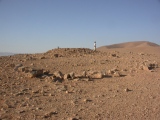
The archaeological project at Deir Mar Musa al-Habashi, involves survey of the catchment of the wadi together with excavation at selected sites. The region is presently extremely arid, and comprises a ridge of limestone, scattered with caves.
For Dr. Robert Mason, an archaeologist with the Royal Ontario Museum, it all began with a walk last summer. Mason conducts work at the Deir Mar Musa al-Habashi monastery, out in the Syrian Desert. Finds from the monastery, which is still in use today by monks, date mainly to the medieval period and include some beautiful frescoes.
Dr. Mason explains that he “went for a walk” into the eastern perimeter of the site - an area that hasn’t been explored by archaeologists. What he discovered is an ancient landscape of stone circles, stone alignments and what appear to be corbelled roof tombs.
Source: University of Toronto and The Independent
Note: A write up of what was found at Deir Mar Musa in Syria - an update from 2012
You may be viewing yesterday's version of this page. To see the most up to date information please register for a free account.


Do not use the above information on other web sites or publications without permission of the contributor.
Click here to see more info for this site
Nearby sites
Click here to view sites on an interactive map of the areaKey: Red: member's photo, Blue: 3rd party photo, Yellow: other image, Green: no photo - please go there and take one, Grey: site destroyed
Download sites to:
KML (Google Earth)
GPX (GPS waypoints)
CSV (Garmin/Navman)
CSV (Excel)
To unlock full downloads you need to sign up as a Contributory Member. Otherwise downloads are limited to 50 sites.
Turn off the page maps and other distractions
Nearby sites listing. In the following links * = Image available
17.9km WSW 252° Yabrud Temple* Ancient Temple
56.5km NW 322° Qamouat el-Hermel Marker Stone
56.5km NW 311° Deir Mar Maroun Ancient Village or Settlement
58.8km W 269° Baalbek Temple * Ancient Temple
59.2km W 268° Baalbek Quarry* Ancient Mine, Quarry or other Industry
66.6km NNW 334° Kadesh Tell* Ancient Village or Settlement
67.8km NW 319° Brissa Stele Sculptured Stone
73.8km SSW 202° Tell Aswad Ancient Village or Settlement
75.6km SW 223° Tal al-Humira Ancient Village or Settlement
76.2km SW 222° Damascus National Museum* Museum
82.3km W 260° Nihata Temple of Hadaranes Ancient Temple
82.3km W 260° Nihata Temple of Atargatis Ancient Temple
82.4km NW 324° Beit Djallou Temple of Nemesis Ancient Temple
83.4km W 261° Hosn Niha Temple C Ancient Temple
83.5km WNW 301° Sfire Temples Ancient Temple
83.6km W 261° Hosn Niha Temple D Ancient Temple
86.6km W 277° Aphaca* Holy Well or Sacred Spring
87.4km WNW 290° Monastery of Saint Anthony of Qozhaya Ancient Temple
90.0km WSW 238° Deir el-Aachayer Temple Ancient Temple
90.6km N 1° Qatna Ancient Village or Settlement
94.2km WSW 245° Majdel Aanjar Tempel Ancient Temple
94.4km SSW 205° El-Leja Desert Kite* Misc. Earthwork
95.1km W 275° Yanouh Ancient Temple
96.4km WNW 288° Qasr Naous Temple Ancient Temple
96.6km WNW 288° Qasr Naous West Temple Ancient Temple
View more nearby sites and additional images


 We would like to know more about this location. Please feel free to add a brief description and any relevant information in your own language.
 Wir möchten mehr über diese Stätte erfahren. Bitte zögern Sie nicht, eine kurze Beschreibung und relevante Informationen in Deutsch hinzuzufügen.
 Nous aimerions en savoir encore un peu sur les lieux. S'il vous plaît n'hesitez pas à ajouter une courte description et tous les renseignements pertinents dans votre propre langue.
 Quisieramos informarnos un poco más de las lugares. No dude en añadir una breve descripción y otros datos relevantes en su propio idioma.