Featured: Stonehenge Tea Towels - Worldwide delivery

 Stonehenge Tea Towels - Worldwide delivery

How and why the ancients enchanted Great Britain and Brittany

How and why the ancients enchanted Great Britain and Brittany

Login

Register here - as a registered user you get more features and fewer ads.

Who's Online

There are currently, 1085 guests and 5 members online.

Sponsors

<< Our Photo Pages >> Manchester Museum - Museum in England in Greater Manchester

Submitted by Andy B on Sunday, 29 June 2025  Page Views: 42981

MuseumsSite Name: Manchester Museum
Country: England
NOTE: This site is 2.1 km away from the location you searched for.

County: Greater Manchester Type: Museum
Nearest Town: Manchester
Map Ref: SJ845966  Landranger Map Number: 109
Latitude: 53.465910N  Longitude: 2.234945W
Condition:
5Perfect
4Almost Perfect
3Reasonable but with some damage
2Ruined but still recognisable as an ancient site
1Pretty much destroyed, possibly visible as crop marks
0No data.
-1Completely destroyed
5 Ambience:
5Superb
4Good
3Ordinary
2Not Good
1Awful
0No data.
5 Access:
5Can be driven to, probably with disabled access
4Short walk on a footpath
3Requiring a bit more of a walk
2A long walk
1In the middle of nowhere, a nightmare to find
0No data.
5 Accuracy:
5co-ordinates taken by GPS or official recorded co-ordinates
4co-ordinates scaled from a detailed map
3co-ordinates scaled from a bad map
2co-ordinates of the nearest village
1co-ordinates of the nearest town
0no data
5

Internal Links:
External Links:

Manchester Museum
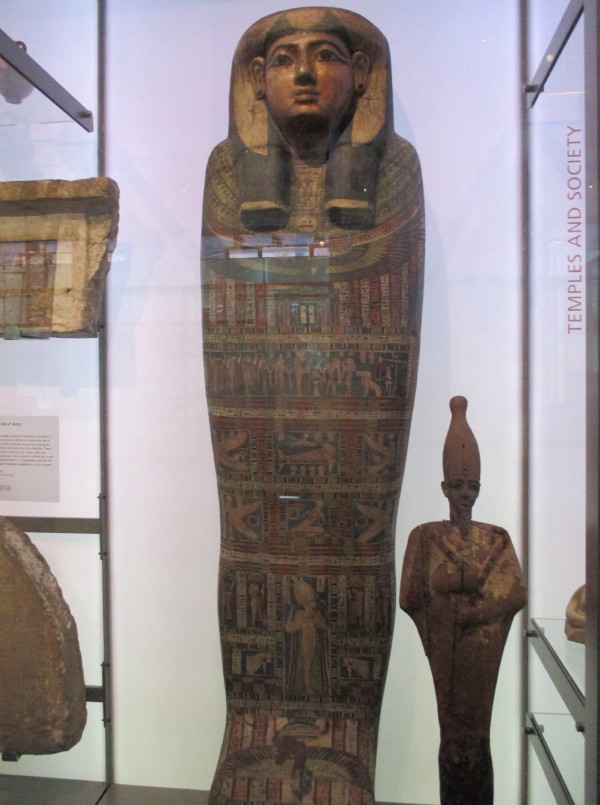
Manchester Museum submitted by DrewParsons : Inner coffin lid for Asru, a temple singer, probably from Thebes and dated to between 747 and 525 BC. September 2014. (Vote or comment on this photo)
Museum in the City of Manchester which includes Egyptian artefacts, and prehistoric stone implements from many sites in the region, including Creswell Crags and Alderley Edge. Lots more on our page.

Address: University of Manchester, Oxford Road, M13 9PL
Phone: 0161 2752634
Opening Hours: Monday to Saturday 10am – 5pm, Sundays and Bank Holidays 11am – 4pm
Admission: Free
Visit their web site

Previous News:
Worsley Man: Hospital scanner probes Iron Age bog death, see comments.
Page originally by Vicky.

Note: Museum asks visitors if Egyptian woman’s body should be taken off display?
You may be viewing yesterday's version of this page. To see the most up to date information please register for a free account.
Manchester Museum
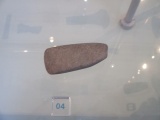
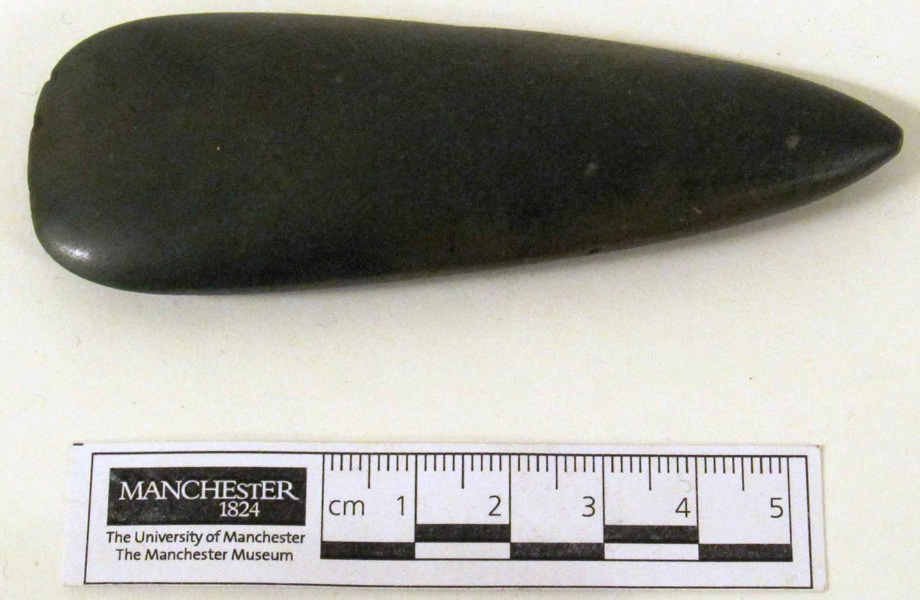
Manchester Museum submitted by Blingo_von_Trumpenstein : Jadeite axe found in France - now owned by Manchester Museum. Not currently on display but if you ask very very nicely they might let you have a private stores visit. I have handled it and it is sensational. I have never held anything so carefully before (including babies!!) . . . Enjoy. Blingo (Vote or comment on this photo)

Manchester Museum
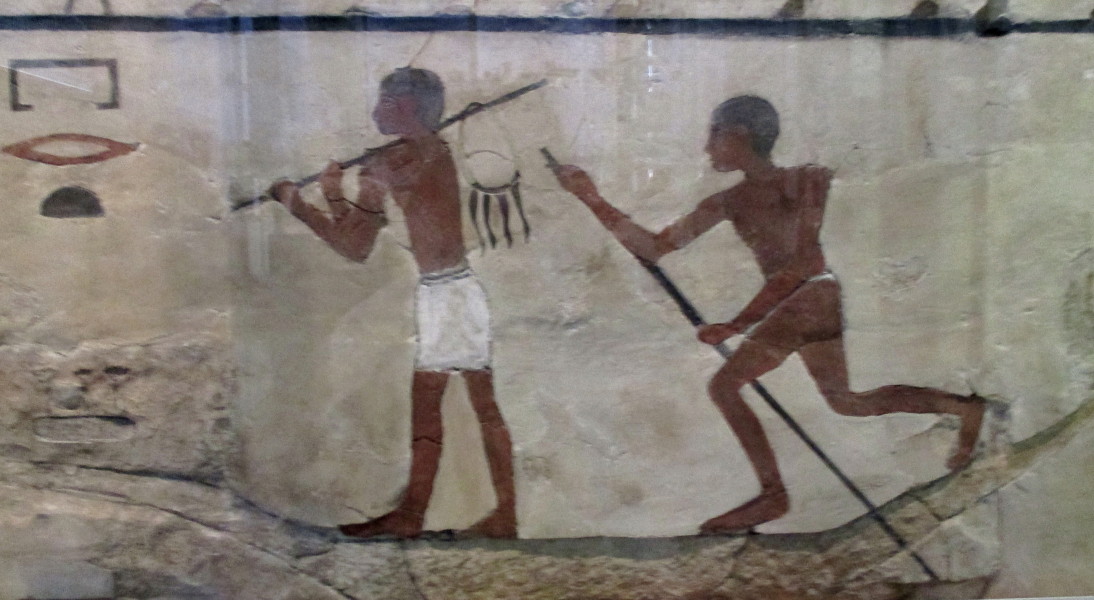
Manchester Museum submitted by DrewParsons : Bottom part of a limestone relief from the tomb temple of Nefermaat and Itet at Meidum dated to 2613-2589 BC. September 2014. (Vote or comment on this photo)

Manchester Museum
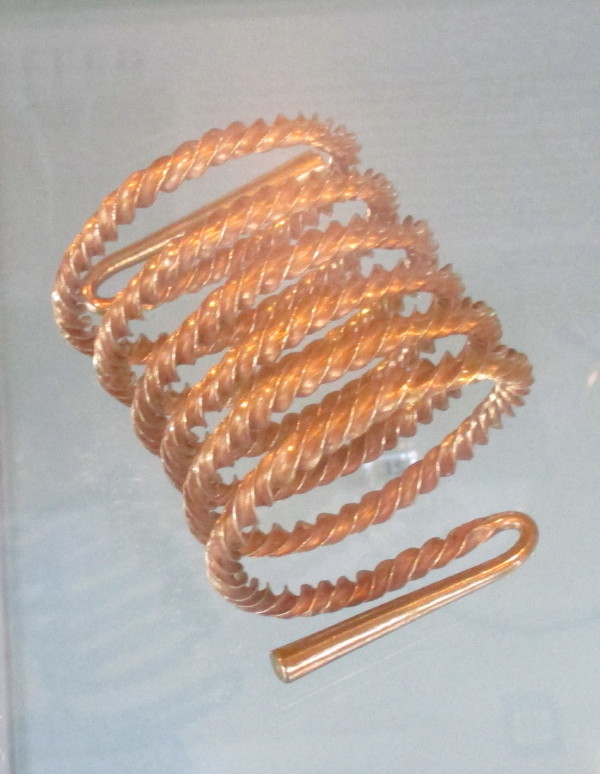
Manchester Museum submitted by DrewParsons : Gold arm band discovered by workmen in 1829 and dated to 1200 BC. Probably made in Ireland. September 2014. (Vote or comment on this photo)

Manchester Museum
Manchester Museum submitted by DrewParsons : Danish tools dated to the Early Bronze Age 1800 - 1000 BC. September 2014. (Vote or comment on this photo)

Manchester Museum
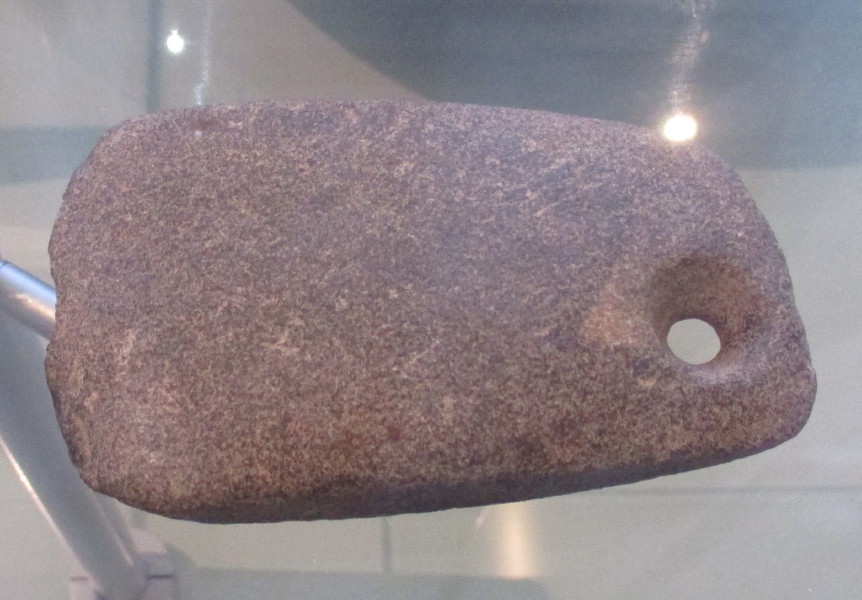
Manchester Museum submitted by DrewParsons : Danish stone axe head with perforation dated to around 2400 to 1800 BC. September 2014. (Vote or comment on this photo)

Manchester Museum
Manchester Museum submitted by DrewParsons : Wooden tomb models from the 1st Intermediate Period to Middle Kingdom Period, Egypt (2160-1650 BC). September 2014.

Manchester Museum
Manchester Museum submitted by DrewParsons : Faience "ankh" symbol for life, and "was" sceptre from 18th dynasty (1479 - 1425 BC). The ankh carries the name of Queen Hatshepsut whilst the was has the cartouche of King Thutmose III. September 2014.

Manchester Museum
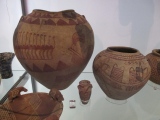
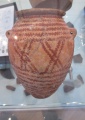
Manchester Museum submitted by DrewParsons : Predynastic D-ware pottery described by Petrie and dated to between 2500 and 2200 BC. September 2014

Manchester Museum
Manchester Museum submitted by DrewParsons : Predynastic pot recovered by Petrie and dated to around 3500 BC. September 2014

Manchester Museum
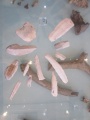
Manchester Museum submitted by DrewParsons : Worked flints from Creswell Crags dated to between 12000 and 8000 BC. September 2014.

Manchester Museum
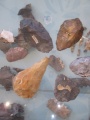
Manchester Museum submitted by DrewParsons : Palaeolithic stone tools from St Acheul, France and Hoxne, England. September 2014.

Manchester Museum
Manchester Museum submitted by DrewParsons : Neolithic stone adze from Brockley Hill Middlesex. September 2014.

Manchester Museum
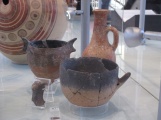
Manchester Museum submitted by DrewParsons : Bronze Age pottery from Vounous Cyprus dated to between 2300 to 2100 BC. September 2014.

Do not use the above information on other web sites or publications without permission of the contributor.
Click here to see more info for this site

Nearby sites

Click here to view sites on an interactive OS map

Key: Red: member's photo, Blue: 3rd party photo, Yellow: other image, Green: no photo - please go there and take one, Grey: site destroyed

Download sites to:
KML (Google Earth)
GPX (GPS waypoints)
CSV (Garmin/Navman)
CSV (Excel)

To unlock full downloads you need to sign up as a Contributory Member. Otherwise downloads are limited to 50 sites.


Turn off the page maps and other distractions

Nearby sites listing. In the following links * = Image available
 4.2km WSW 256° The Great Stone (Trafford)* Natural Stone / Erratic / Other Natural Feature (SJ8043395580)
 4.3km SE 137° Cringle Park* Modern Stone Circle etc (SJ87399347)
 6.9km WNW 287° St Mary the Virgin (Eccles) Ancient Cross (SJ77899868)
 8.0km S 172° St Mary (Cheadle, Stockport) Ancient Cross (SJ85668864)
 10.1km NNE 15° St Leonard (Rochdale)* Ancient Cross (SD872063)
 10.8km NW 319° Giant's Seat Hillfort (SD775048)
 11.4km ESE 124° St Chad's Well (Chadkirk)* Holy Well or Sacred Spring (SJ93979027)
 12.0km ESE 105° Lower Higham Farm Cairn (SJ961935)
 12.0km ESE 108° Werneth Low (Hyde) Ancient Village or Settlement (SJ959928)
 12.3km ESE 104° Hangingbank, Werneth Low* Ancient Village or Settlement (SJ96479352)
 12.9km ESE 106° Werneth Low Cairn Cairn (SJ969929)
 13.0km NW 323° Radcliffe Hillfort (SD767070)
 13.0km ESE 105° Werneth Low Enclosure Ancient Village or Settlement (SJ97099315)
 13.2km WNW 289° Boothstown Round Barrow(s) (SD720010)
 14.4km E 87° Buckton Edge Cairn (SJ989972)
 14.4km E 84° Stalybridge Cairn* Cairn (SJ989980)
 14.5km E 84° Hobson Moor Cairn I Cairn (SJ990980)
 14.6km E 87° Hobson Moor Cairn II Cairn (SJ991972)
 14.7km S 182° Manchester Ship Canal Stone* Marker Stone (SJ83898193)
 15.1km WSW 256° Great Woolden Hall Ancient Village or Settlement (SJ698929)
 15.2km SW 228° Fairy Brow Round Barrow(s) (SJ73088654)
 15.2km ENE 77° Harridge Pike Cairn (SJ994999)
 15.2km ENE 71° Buckton Castle Hillfort (SD9890501634)
 15.4km ESE 112° Brown Low* Round Barrow(s) (SJ988909)
 15.4km ESE 110° Ludworth Intake* Round Barrow(s) (SJ98989131)
View more nearby sites and additional images

<< Dewerstone

Allée couverte de Pont-Bertho >>

Please add your thoughts on this site

Britain's Oldest Art: The Ice Age Cave Art of Creswell Crag

Britain's Oldest Art: The Ice Age Cave Art of Creswell Crag

Sponsors

Latest Visit Logs

  • Badnabay
    “A short walk through rather boggy ground towards the west end of the horseshoe-shaped road coming of…”
    by RingPaw · 7 Jun 2026
  • Tsankawi
    “The complete Tsankawi Village loop trail is about 2 miles round trip. The parking lot is large, pave…”
    by stonetracker · 6 Jun 2026
  • Dun Beag (Struan)
    “Nothing much to add to earlier comments - a short walk but steep in parts. A spectacular site, defin…”
    by Glaschu · 5 Jun 2026
  • Gwal y Filiast
    “Did the anti clockwise circular walk from login, track through field by Dickman (timber merchant) is…”
    by Possumputer · 4 Jun 2026
  • Dun Buidhe
    “Access - it's easy to get to the causeway. You walk across one island which is rough ground but noth…”
    by Glaschu · 3 Jun 2026

"Manchester Museum" | Login/Create an Account | 19 News and Comments
  
Go back to top of page    Comments are owned by the poster. We aren't responsible for their content.
Manchester Museum asks visitors if Egyptian woman’s body should be taken off display by Andy B on Sunday, 29 June 2025
(User Info | Send a Message)
Asru, who lived 2,700 years ago, has been on display for two centuries but museum is trying to ‘decolonise’ exhibits
by Chris Osuh Community affairs correspondent
Sun 29 Jun 2025

One of Europe’s leading museums is asking visitors if it should continue to display the body of an ancient Egyptian woman 200 years after it was brought to the UK by cotton merchants, as it “decolonises” some of its most famous exhibits.

Manchester Museum, which in May was named 2025’s European museum of the year, is running a consultation on the future of Asru, a woman who lived in Thebes, the ancient city in the location of modern-day Luxor, 2,700 years ago.

A plaque at the museum asks: “Should we continue to display the body of Asru?”, inviting visitors to submit answers in a postbox underneath.

It adds: “Asru’s mummified body was unwrapped at the Manchester Natural History Society in April 1825. She has regularly been on display for the two centuries since. In that time, we have also changed as a museum and are thinking more about how we care for people.”

The story of Asru’s body is one of several that show how the development of the UK museum sector benefited from colonialism and transatlantic slavery, at a time when the ethics of displaying human bodies and spoils from imperial expansion are being questioned.

In March a report by MPs from the all-party parliamentary group for Afrikan reparations called for bans on selling ancestral remains and publicly displaying them without consent.

Asru’s finely decorated wooden coffin reveals a few biographical details. An affluent woman who was about 60 when she died, her father was called Pa-Kush, which means “the Kushite”, a Black man from modern-day Sudan. Pa-Kush worked as a scribe, a high-status role, when Egypt had Kushite pharaohs. Asru’s name means “her arm is against them”.

In the 19th century, Asru’s sarcophagus was acquired by Robert and William Garnett, the sons of a former trader in enslaved African people, who had followed him into the cotton industry, research by one of the museum’s curators, Campbell Price, found. The Garnetts donated Asru’s body to the Manchester Natural History Society, the forerunner to Manchester Museum.

Read more at
www.theguardian.com/culture/2025/jun/29/manchester-museum-asks-visitors-if-egyptian-womans-body-should-be-taken-off-display
[ Reply to This ]

Video: Alan Garner tells the story of the Bronze Age Sainters shovel by Andy B on Tuesday, 14 September 2021
(User Info | Send a Message)
Sent in by Jackdaw: The Shovel

A curious history of a shovel,'garnered' and presented by Cheshire's very own treasure,Alan Garner...

One of 7 short videos on the subject from the Manchester museum.
Simply click on "autoplay" on you tube to view them in succession.


https://www.youtube.com/watch?v=L6GegYhVK0E&t=271s
[ Reply to This ]

Re: Manchester Museum by neolithique02 on Wednesday, 26 September 2012
(User Info | Send a Message)
After 12 years of field surveys in the Italian Alps, outcrops of jades (jadeitite, omphacitite, eclogite), exploited from the end of the sixth millennium B.C., were discovered by Pierre and Anne-Marie Pétrequin. This discovery was the subject of the research project “JADE”, developed between 2006 and 2010.

It was a great discovery because most geologists and archaeologists believed Alpine jades had been gathered only from secondary sources in river valleys. In 2003, they were proved right when they found high-altitude quarries – 1800–2450m od – at the south-east foot of Monte Viso, 60km south-west of Turin. In November that year, they struck green gold again, in the vicinity of Monte Beigua, part of the Voltri massif, immediately to the north-west of Genoa.

From these 2 quarries, Jade axe-heads circulated for considerable distances — that is 3,300 km from the West to the East, Ireland to Bulgaria, and more than 2,000 km from the North to the South, Denmark to Sicily —...

Read the rest of this post...
[ Reply to This ]

Re: Manchester Museum by bigbobswinden on Sunday, 18 March 2012
(User Info | Send a Message)
The stone axe shown in the picture above is apparently so perfect symmetrically and in the removal of all the hollows caused by the flaking to shape it must have taken an expert a very long time to make. has anyone ever repeated the feat to find out? Also is it a symbol of power, as in its rough shape it would do a job.
[ Reply to This ]
    Re: Manchester Museum by Blingo_von_Trumpenstein on Monday, 19 March 2012
    (User Info | Send a Message)
    The axe in the picture is made from Jadeite from high up in the Italian Alps (Monte Viso). It is not a material that flakes as flint does. It would have been pecked with a hammerstone (hit hard to remove crushed areas) and then polished on a (probably very special) polishing stone (polissoir) with water and quartzite dust and then possibly polished to a mirror polish by using pig fat and leaves. There are various estimates on how long this would have taken but it could easily be several weeks. The material is so sacred and rare that I am certain it would have been polished to the most extreme finish. I know from personal experience that it is the final perfect polish that really takes the time.
    This is not an axe that has ever been used. It has no usage marks or hafting evidence (as all neolithic jadeite axes). My educated opinion is that they were carried permanently in a leather pouch and used as a magical item. I have held many of them and they feel very magical. They make me...

    Read the rest of this post...
    [ Reply to This ]

Worsley Man: Hospital scanner probes Iron Age bog death by bat400 on Wednesday, 14 March 2012
(User Info | Send a Message)
The head of an Iron Age man who died almost 2,000 years ago has been scanned in a Manchester hospital to shed light on how he died.

Worsley Man is thought to have lived around 100 AD when Romans occupied much of Britain. Since its discovery in a Salford peat bog in 1958, the head has been kept at Manchester Museum on Oxford Road.

The scans at the Manchester Children's Hospital have now revealed more details about his violent death. Doctors said CAT scan tests revealed damage to the remains of his neck, almost certainly caused by a ligature.

Speculation about the death of the man, thought to be in his 20s or 30s, has previously included robbery or human sacrifice.

Bryan Sitch, curator of archaeology at Manchester Museum, said it now appeared the man was bludgeoned over the head, garrotted then beheaded.

He said: "The radiology staff at the hospital were quite excited to have a 2,000-year-old patient.

"This really was an extraordinary level of violence, it could be that there...

Read the rest of this post...
[ Reply to This ]

Manchester Museum - Henge Diggers Exhibition by TimPrevett on Tuesday, 01 March 2011
(User Info | Send a Message)
Until 17 Jul 2011

Photos by Bill Bevan and emotive texts capture the feelings of archaeologists, some from The University of Manchester, as they dig and make discoveries near this renowned sacred site.

As well as capturing the feelings and emotions of the archaeologists as they work on the Stonehenge Riverside Project, the photos and texts document the structured approach archaeologists take to excavate ancient sites. Free entry


Visit our website for more info about Stonehenge: henge diggers

http://www.museum.manchester.ac.uk/whatson/exhibitions/stonehengehengediggers/
[ Reply to This ]

Manchester Museum by Blingo_von_Trumpenstein on Tuesday, 01 February 2011
(User Info | Send a Message)
Manchester Museum is very good. Superb archery display including Mary Rose yew longbow. Extensive Egyptian displays. Really good mineral cabinets. Also a few meteorites. No stone axes on display but I have had a stores visit and handled their French jadeite axe. I still tingle to think of it.
Free to get in with lovely staff.
Definitely worth a visit.

Blingo
[ Reply to This ]

Re: Lindow Man leaves British Museum 'home' by Anonymous on Friday, 29 August 2008
It will be good to see Lindow Man back at the Manchester Museum. the display was spectacular and full of information last time. He was a real focus of attention. When we saw Lindow Man at the British Museum he was tucked in a corner and we had to search for him!
[ Reply to This ]

Re: Lindow Man leaves British Museum 'home' by Anonymous on Monday, 28 April 2008
I still favor the "Life and Death of a Druid Prince" by Anne Ross' research, as a great explanation, for this unique individual. Since science is now able to explain where a person once lived, Such as the "Oetzi" Man, and the "Archer King" near Stonehenge, why haven't we seen more scientific research to prove or disprove anything concerning this individual ?
[ Reply to This ]

Re: Lindow Man leaves British Museum 'home' by Andy B on Thursday, 24 April 2008
(User Info | Send a Message)
One of the British Museum’s most popular exhibits is on loan to Manchester Museum for the next year.

Lindow Man was discovered in 1984 on Lindow Moss in Cheshire. Since then scientists, archaeologists, historians, curators - and the public - have been eager to find out more about him.

A Bog Body Mystery looks at the story of Lindow Man through seven different inquisitive minds, including those of a forensic archaeologist, a peat digger, a curator and a druid priest.

Exploring a variety of perspectives, viewpoints and experiences, the exhibition doesn’t seek to answer the mystery but discuss its possibilities and explore what Lindow man means to us today.

A number of different objects have been used to both illustrate and contextualise the story of Lindow Man, and they vary from the Wandsworth Shield Boss to Care Bears. The objects have been chosen to provide personal insights into what Lindow Man means to people - past and present.

“Perhaps we still need Lindow Man to...

Read the rest of this post...
[ Reply to This ]

Re: Lindow Man leaves British Museum 'home' by Anonymous on Wednesday, 30 January 2008
At least now there will be ONE British artefact on display in Manchester Museum.
[ Reply to This ]

Lindow Man leaves British Museum 'home' by Andy B on Tuesday, 29 January 2008
(User Info | Send a Message)
The remains of an Iron Age man found in a peat bog are leaving the British Museum for the first time in 17 years.
was found in a Cheshire marsh in 1984, nearly 2,000 years after his horrific death.

Chemicals in the bog preserved the body and researchers found his throat was slit and he was garrotted, possibly as a sacrificial victim.

Lindow Man is being moved from London to the Manchester Museum, on long-term loan, and will be displayed from April.

He was found on Lindow Moss near Wilmslow and is the best preserved body of its era in the UK.

Study of the remains by scientists has improved knowledge of Iron Age activities and made it possible to see the face of a person from the prehistoric past.

Last meal

The man, who died when he was about 25, has a distinctive furrowed brow with close-cropped hair and a beard.

Scientists discovered his last meal was a piece of unleavened bread.

He has been on display in the Manchester Museum twice before, in 1987...

Read the rest of this post...
[ Reply to This ]

Re: Manchester Museum by Vicky on Wednesday, 05 May 2004
(User Info | Send a Message)
We visited the recently refurbished Museum at the weekend and were very dissapointed as there wasn't a single British prehistoric artefact on display despite the large number of finds that have been uncovered in the area (and are reputedly in the Museum store). Even the promising sounding gallery 'Pre-historic life' is full of nothing but dinosaurs. There was lots of Egyptian artefacts to see but what relevance are these to the kids of Manchester?

While we were in Manchester we also went to Castlefield to look at the visitor's centre and the reconstruction of the Roman Fort only to discover that the visitor's centre had been sold for luxury flats (advertised as 'Vicus' = 56 luxury flats built on the site of a Roman Settlement!) and the lovely noticeboards around the fort reconstruction were all covered in graffitti! Very sad.
[ Reply to This ]

Your Name: Anonymous [ Register Now ]
Subject:


Add your comment or contribution to this page. Spam or offensive posts are deleted immediately, don't even bother

<<< What is five plus one as a number? (Please type the answer to this question in the little box on the left)
You can also embed videos and other things. For Youtube please copy and paste the 'embed code'.
For Google Street View please include Street View in the text.
Create a web link like this: <a href="https://www.megalithic.co.uk">This is a link</a>  

Allowed HTML is:
<p> <b> <i> <a> <img> <em> <br> <strong> <blockquote> <tt> <li> <ol> <ul> <object> <param> <embed> <iframe>

We would like to know more about this location. Please feel free to add a brief description and any relevant information in your own language.
Wir möchten mehr über diese Stätte erfahren. Bitte zögern Sie nicht, eine kurze Beschreibung und relevante Informationen in Deutsch hinzuzufügen.
Nous aimerions en savoir encore un peu sur les lieux. S'il vous plaît n'hesitez pas à ajouter une courte description et tous les renseignements pertinents dans votre propre langue.
Quisieramos informarnos un poco más de las lugares. No dude en añadir una breve descripción y otros datos relevantes en su propio idioma.